
King Charles and his family’s honour
Written by Rob on juni 13, 2026
Introduction
In 2022 the newspaper The Irish Sun wrote that then future King Charles was willing to lend his ‘broke brother’ Andrew to save family honour.

The use of the term family honour is of course interesting. Let us see what the journalists mean by ‘family honour’, and have a look at the underlying external and internal social processes.
The course of events
Attempt to cover up
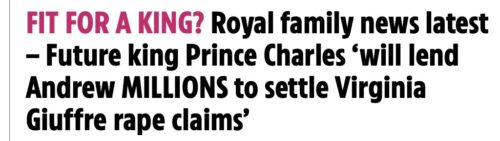 The English royal family collected the money in order to settle with Virginia Roberts Giuffre. Since 2014, Ms Giuffre had been accusing Andrew of having raped her when she was only 17 years old, while Jeffrey Epstein (1953-2019) and Gislaine Maxwell organized and facilited the encounters (The Irish Sun, 8-3-2022).
With the settlement the affair was covered up. Sadly, Virginia Giuffre died by suicide in April 2025. In her book, which was published after her death, she nevertheless describes the occasions when she and Andrew allegedly had sex.
Andrew appears in the ‘Epstein Papers’
Still, the accusations against Andrew lingered on. Yet Andrew was protected by his mother Queen Elizabeth, who died in September 2022.
Giuffre’s allegations were partly confirmed as Andrew’s name appeared in the so-called ‘Epstein files’, which were published after November 2025, as a close friend of Jeffrey Epstein. Andrew appears to have remained in contact in 2011, years after Epstein had been convicted for pedosexual contacts in 2008 and, importantly, after his formal registration as a sex offender in 2011 (Wikipedia, ‘Jeffrey Epstein’).
‘In March 2022, the man still known as Prince Andrew was in disgrace, his reputation shredded by increasingly lurid revelations about his ties to the sex offender Jeffrey Epstein’ (NY Times, 21-2-2026).
On February 19th, 2026 (his birthday) Andrew was arrested on suspicion of having leaked sensitive and confidential government information to Jeffrey Epstein while serving as a UK international trade envoy between 2001 and 2011.
Feeling ‘betrayed’
During all this, according to media reports, on a personal level the relations between the brothers Charles and Andrew soured too. Charles allegedly does not talk to Andrew anymore because he allegedly feels ‘personally misled’ (Yahoo, 14-4-2026).
This relates to ‘a massive conversation’ Charles and Andrew had about Epstein in 2013 or 2014. Andrew gave him ‘his complete and utter assurance that he had done nothing wrong’. Therefore, the affair has cut into the trust between Andrew and Charles (Yahoo, March 20, 2026).
Andrew’s problems in British society
From 2014 on, his relationship with Epstein must have caused an immense pressure on Andrew. He had to give up important functions and titles.
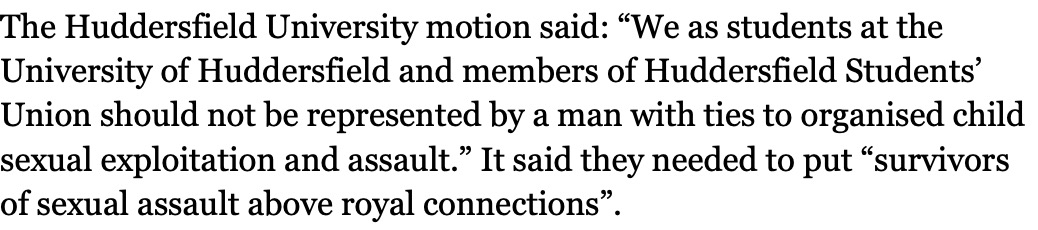
For example, in November 2019, the Students’ Union of the University of Huddersfield wanted Andrew to resign as its chancellor, which he did two days later (University World News, 23 November 2019).
Other family members interfere too
William, the crownprince to the British throne, is reported to have been ‘furious’ as well. In 2019 Andrew had given an interview in BBC Newsnight, ‘where he failed to apologise for his connection to Epstein, or acknowledge the victims of sexual abuse’. This missed chance was, ‘for William and his wife Catherine, terminal for their relationship with him’ (The Mirror, 13-2-2026).
 William considered that Andrew constituted a ‘stain on all the family’, and he therefore feared for his own future (The Nightly, 14-2-2026).
William’s harsh position against his uncle Andrew is, according to some, understandable:  “William has been brutal … but with good cause” (UK Barrister Andrew Eborn in SKY News Australia, 18-2-2026).
Charles ‘axes’ his brother
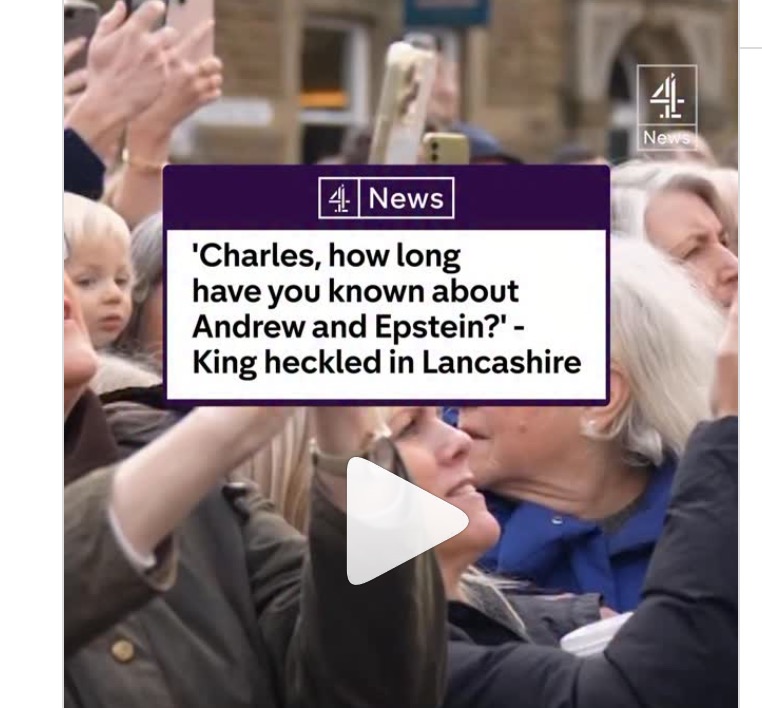 While British society and the rest of the world questioned the stances of the other royals, some wondered is whether they knew about Andrew’s behaviour (Instagram, 9-2-2026).
King Charles saw no other option than to distance from his brother. He took away Andrew’s remaing royal titles – making him no longer a prince.  The act of distancing is expressed by means of different verbs: Charles ‘axed his brother’ (Telegraph, 31-1-2026), he ‘banished’ him (CNN, Oct 31, 2025), ‘he renounces him’ (Wall Street Journal, 5-2-2026) and he ‘cast him out’ (CNN, 31-10-2025). In an interview in March 2026 Charles did not once use the word ‘brother’ (The Royal Observer, 17-3-2026).
Physically thrown out
In addition, Charles also decided to physically put Andrew away out of the Royal Lodge, part of the crown-owned mansion, and forced him to move to Sandringham.
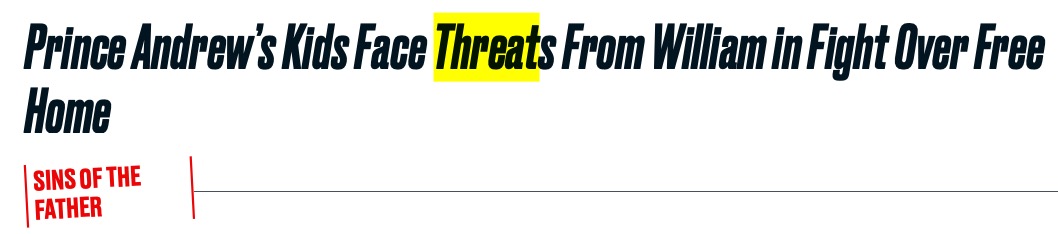 Prince William allegedly put pressure on his cousins, as he is said to have ‘threatened Princess Eugenie and Princess Beatrice with the removal of their titles if their father, Andrew Mountbatten-Windsor, does not move out of Royal Lodge’ (The Daily Beast, 28-10-2025).
One reason Andrew did not want to move, was his fear for ‘security threats’.

Indeed, not long after he moved to Sandringham, in at least one incident he was threatened and attacked by a man while walking his dogs (RTE News, 8-5-2026).
Why is Andrew cast out?
The measures to take distance from Andrew are needed to ‘take swift action’ to ‘limit reputational damage’ (The Nightly, 14-2-2026) and ‘save the monarchy’ (Telegraph, in Yahoo, 20-3-2026).
Yet ‘Charles […] can never erase the damage’ (Sunday Times, in Yahoo, 20-3-2026).
Discussion
Why family honour?
Why is the ‘family honour’ in great danger? Why are all family members ‘furious’ and upset? And why are all these violent actions against Andrew needed, condoned and even demanded for?
One thing is clear, ‘family honour’ cannot merely refer to King Charles’, the late Queen Elizabeth’s or Prince William’s feelings being hurt by Andrews behaviour or the rumours concerning him. Nor is honour merely their ‘status’.
So, then how should we interpret honour here?
Moral reputation
While the English word ‘honour’ has various significations (unlike some words for ‘honour’ in other languages), the one that is meant here is ‘moral reputation’.
People whose moral reputation is intact, are trusted in their communities. They are welcome in their neighbourhoods, acceptable as reliable friends, as spouses, as co-workers, as sportsmen, singers and entertainer on a party, employees, social workers, as members of a club and as kings, queens and princes (Ellemers, 2020).
When someone is believed to have committed immoral behaviour, such as fraude, theft, violence, or rape this trust vanishes (Ellemers, 2020).
Because of his immoral behaviour and his friendship with the convicted paedophile Epstein, Andrew got his moral reputation damaged when the public learned from his immoral behaviour in the recent past. This caused a moral stigma for Andrew himself in the first place.
A damaged moral reputation: distrust and stigma
Community members lose their confidence in the immoral individual, who may find themselves being expelled from their neighborhoods, get ‘the cold shoulder’ from former friends, co-workers, neighbours, and acquaintances. In brief: they acquire a moral stigma and are likely to be ostracized (Case and Williams, 2004). (Some people cannot bear the ostracism and commit suicide in the wake of serious accusations or a pending trial.)
All of this has apparently happened to Andrew, who received many negative responses throughout UK society. He was even attacked physically.
The stain sticks to others
A moral stigma, ‘stain’ or a ‘blemish’, easily sticks to people who belong to the same group as the deviant, especially family members. This is called a stigma-by-association or courtesy stigma (Goffman, 1963). (A moral stigma may also stick to other groups, for example companies or even countries where the people in charge are thought to have trespassed moral boundaries.)
In general, the closer the relationship with the members of the group and the deviant, the more likely the risk that such a secondary stigma (also a stigma-by-association or a courtesy stigma) attaches to that group of people the deviant is associated with (Condry, 2007).
Community members then question or ‘heckle’ family members about their fellow family member, the deviant, about their opion on the deviant’s immoral behaviour, and, importantly, whether they knew about it.
Some families attempt to defend their family member by alleviating the context: she was still young, he had a black out, he has been ill, her father died recently, etc.
Controlling and ‘heckling’
Families in this context control, sometimes threaten, the deviant in order to constrain their behaviour. The goal is to prevent them from to indulging again in the disputed behaviour.
Note: this is one context of what in Denmark and Norway is called negative social control, but is there understood entirely differently (as acknowledged by Smette e.a. 2026).
 From now on they want the deviant not to draw attention anymore to themselves, he should ‘lie low’ and ‘fade into the background’ (Marie Claire, 16-8-2025) or ‘vanish’ (Fox News, 13-3-2025). If they feel pity for the deviant, it is better not to show it too explicitly.
Prevention of a moral stigma
In order to prevent a moral stigma for both the deviant and the associates, and evade being ostracised, families often first attempt to cover up the problem; things the public does not know about, cannot cause a stigma. Sometimes covering up costs money.
Note that blackmail is often related to one’s moral reputation: the blackmailer threatens to publish or distribute details over the victim’s alleged immoral behaviour. If there has not been any actual immoral behaviour, it is nowadays easy to fabricate with the help of AI such details in a convincing manner.
The effect of publication or distribution of photo’s or films is a moral stigma and ostracism, both for the direct victim of the blackmail in the first place, and the members of their closest group, their family members. The victim often fears disputes and fights with their family members.
Feelings of disappointment
Often the associates express feelings of disappointment and anger; they feel personally betrayed by the deviant. Family members genuinely fear for their future, their position in community.
They believe their deviant family member clearly did not have the common well-being of all family members in mind, they followed their own low and despicable selfish impulses and endangered all of them.
Alleviating the moral stigma
When community pressure becomes unbearable, especially when family members, including minors, are harrassed or ostracized by strangers, the relationship with the deviant is likely to sour, some individuals from the family will threaten or even abuse them — no doubt, like Prince William, ‘with good cause’.
Under community pressure and the risk of being ostracized, family members may see no other option than to publicly take distance from the deviant. It is in their interest that the general public from then on hears as little about the deviant as possible.
No punishments
These actions are not meant in the first place as punishments for the deviant family member, they are necessary to save the associates’ own moral reputation. In this context words like ‘stain’, ‘reputation’ and ‘honour’ are often used.
After the family (publicly) has taken distance, people in the community understand that they do not want to be associated any longer with the deviant. From this moment on, for the associated family members the situation may gradually improve. In this context, King Charles said they will support the police in the investigation (AlJazeera, 9-2-2026).
Universal social process
With this analysis of the current predicament of the British royal family I believe to have illustrated that the course of events depicted here shows many characteristics common to honour related cases in general. Note that the status and titles only play a marginal role here.
These same characteristics can also be discerned in cases of non-western people and their families. It is a universal social process.
Social sanctions
Honour related violence is in essence a response to individuals who (allegedly) transgress the moral norms (not social norms) of their community. One context is that of community members who attack, spit or ignore the deviant
Therefore I argue that the physical attack against Andrew can also be labeled as a type of honour related violence.
Fear of being ostracised
Another context for honour related violence is constituted by the associates’ fear for a stigma-by-assocation, in other words: the fear of being ostracized in the community as the result of the deviant’s immoral behaviour. This fear in some families causes panic and internal rifts, threats, violence and in some cases the final casting out of the deviant.
This fear may be genuine and realistic, even if outsiders do not consider the disputed behaviour as morally wrong. This is often the case when social workers deal with (honour related) cases among immigrants from other parts of the world. Merely addressing this fear and asking the right questions may already de-escalate the situation.
Unless … one believes that in the minds of non-western individuals and their families operate some opaque ‘culture-related’ mechanisms that are very distinct from all of this.
Further reading
- Case, T. I. and Williams, K. D. (2004). Ostracism: A Metaphor for Death. In Greenberg e.a. eds. Handbook of Experimental Existential Psychology, ch. 21, pages 342–357. Guilford, New York.
- Condry, R. (2007). Families Shamed. Willan Publishers, Cullompton.
- Ellemers, N. (2017). Morality and the regulation of social behavior. Routledge, New York.
- Ermers, R. 2018. Honor Related Violence. A New Social-pscychological Perspective. Routledge.
- Goffman, E. (1963). Stigma. Prentice-Hall, Englewood Cliffs, N.J.
- Smette, I., e.a. (2026). Når ‘negativ sosial kontroll’ er bestillingen. Tidsskrift for samfunnsforskning, 67(1):1–14.
Geef een reactie